2019-06-04
The lace industry is recovering again, Tainan's old stores are transforming into cultural and creative enterprises
The lace industry once reached its peak in the 1980s and grew along with Taiwan's prosperous textile industry. However, as the industry moved westward and overseas, the lace industry quickly withered. But now there is an old lace shop in Tainan that insists on refusing to blow out the lights. In addition to combining lace with bags and scarves, it has also opened a cultural and creative concept store to present the beauty of lace to the public more directly.
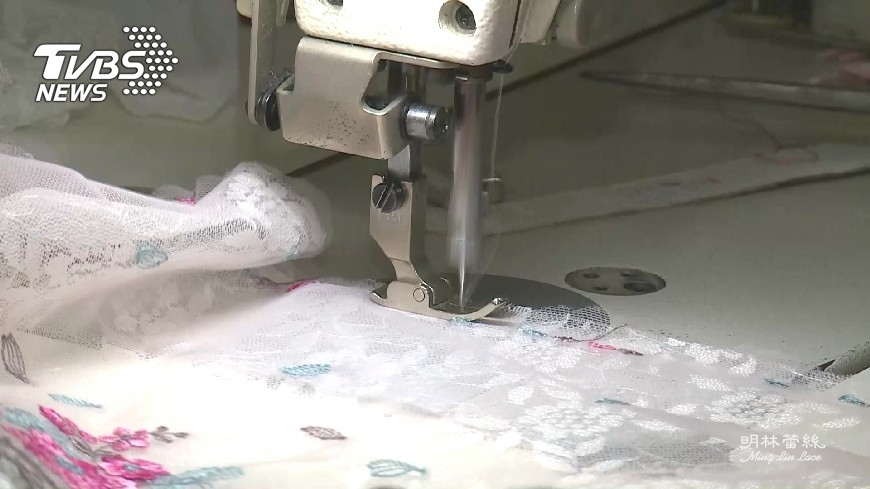
The 70-year-old master, who has gray hair, carefully sews lace onto the fabric in front of a sewing machine. She can sew 400 to 500 laces in one day. She has been doing this kind of work for half a century, but the master At the boss's insistence, I never thought about retiring.
Lin Shuzhen, a lace shop owner in Tainan: "On this aspect, there will actually be a gap in manpower, which we are more worried about, because in fact, Taiwan's industry is built on these traditional industries.
Lin Shuzhen is the owner of this local lace shop in Tainan. The successor of an old lace shop that has been in business for nearly a century, his R&D room is staffed by master craftsmen and senior designers who continue to work hard for Taiwan's lace industry.
Senior designer: "This is the front, this is more beautiful, I'm afraid it will cost more."
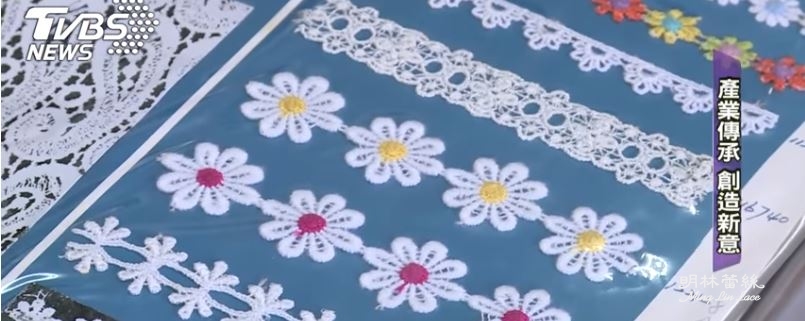
Various lace patterns look even better when matched with fabrics. If you are still not satisfied, there are many lace samples to choose from.
Reporter Zhan Shuhan: "There are nearly a dozen lace samples collected on these old wooden cabinets. As long as you can find them, they can still be produced."
In addition to the wooden cabinets full of samples, the thick sample books are also the hard work accumulated since the previous generation. However, as the industry later moved westward, it has gone from 200 to 300 cooperative manufacturers in its heyday to now There are less than 100 stores left, but they were unwilling to rush to the other side. The old lace stores in Taiwan are still struggling to survive, but they are still unwilling to give up easily even though it is still very difficult.
Lin Shuzhen, a lace business owner in Tainan: "You can't say that you will do it when you make money, and you won't do it if you don't make money. Instead, you have to think about how to transform and transform so that this industry can continue to be maintained or even develop. "
No longer just a supplier behind the industrial chain, the old lace store has opened a cultural and creative concept store in downtown Tainan, using lace to make various accessories, including hats, scarves, shoes, and bags. Although Tongtong has just started, But it has also begun to be close to people's daily consumption.
Reporter Zhan Shuhan: "And how were these very beautiful laces weaved in the first place? You can see that there are many mallets wrapped with silk threads, so in the earliest times, they were woven by hand. Just this mallet , there are hundreds of kinds all over the world."
Bangchui lace teacher Zhang Keyen: "The most famous types of lace at present are Danish lace, Belgian lace, and this kind of Russian lace."
In the classroom, students are following the teacher attentively to learn how to make lace.
Tainan University of Applied Science and Technology established the only embroidery research center in Taiwan in 2002, hoping to cultivate relevant talents that are gradually withering.
Tainan University of Science and Technology student: "I originally majored in clothing, but recently I discovered that more and more lace and embroidery are being used in clothing, so I think it is one of the trends in the future."
Tainan University of Science and Technology student: "It's just that lace has some concepts of weaving, and I will use it in my own creations."
In addition to traditional hand-making, there are also modern pattern-making design and electric embroidery related courses. We hope that students can gain exposure to them in many ways.
Cai Yijin, director of the Embroidery Center of Tainan University of Applied Science and Technology: "As the older generation slowly retires and leaves the workplace, there is no way to pass on the skills in this area. This is also because these craftsmanship skills are limited by the talent entering the industry. fault, so we also hope to pass on this skill. The transformation of old lace stores has just begun, but talent cultivation does not happen overnight. How to let the younger generation learn to contact and even invest in development is what the traditional textile industry should think about Cultivate a source of innovation.